
Partial-home versus whole-home backup
When looking at sizing any backup system whether a gas generator or a solar and battery system the first question you will have to answer is do you want partial or whole home backup. Whole home backup won’t warrant much of a description other than stating your entire home will be able to run in the event of a grid outage, short and sweet. While this is easier to achieve with a fossil fuel consuming generator doing the same with solar and battery is a little more challenging and increases costs that put this type of system out of reach for most people. For a typical Front Range home, a partial home solar and battery system runs about $40,000 to $53,000, while a whole home system runs about $57,000 to $77,000, and up to $100,000 with generator integration. Here in Colorado the average home is without power for about 3 to 6 hours per year. This varies dramatically depending on your location but even if we go above “average” and go off a 24-hour outage you are still spending 0.3% or less of your time per year potentially in the dark without either of these backup systems. That leads to an important question: during that time, will you need to use your hot tub, or use an electric dryer, or be able to cook with your electric cooktop, Air Conditioning or even charge your EV? I understand that some people may have strong preferences but if most of my lights, my internet, and if in winter my heat is on along with a few other outlets, etc., I will be just fine for a few hours.
Sizing solar and batteries for essential loads
This write up will focus mostly on Solar and Battery systems and explain why partial home backup makes the most sense for most customers here in Colorado. The average home in Colorado consumes about 8,100 kWh of energy per year, but the homes we typically install on use more. Let’s assume a range of 11,000 kWh to 15,000 kWh per year. When sizing most solar PV systems we want to size it to offset your utility bill to get as much ROI out of the system as possible. In Colorado each kW of solar produces roughly 1,450 to 1,500 kWh per year, so offsetting that usage takes about 7.5 kW DC to 10 kW DC of solar. With modern panels rated at about 420 watts, that works out to about 18 to 24 solar panels on a roof. For a home using 13,000 kWh per year, daily energy usage comes out to about 35 kWh per day (13,000/365). Because solar will still produce during a grid outage we ideally want to size a battery to last close to the longest evening in a year. Since we are doing partial home and we are taking out any large loads we can plan for about 15 kWh per day of essential usage. That is less than half of what the whole home uses, which makes sense once the large loads are off backup. Because our PV system was sized to offset our entire load it is safe to assume we will have excess solar during the day which will recharge the batteries every morning and then once charged offset our load until the sun goes down. With about 7 hours of good sunshine, on a clear day we should be able to not only charge the batteries to 100% but also cover the home’s load for those 7 hours. This holds up in winter too: refilling the battery and running the home takes about 16 kWh on a short December day, and our array produces well over that on a clear day, leaving some margin for partly cloudy days. If we are using about 0.6 kW on average (15 kWh/24 h), our nighttime load over about 17 hours will be roughly 10.6 kWh. With this in mind we can safely design our battery bank at about 13.5 kWh to 15 kWh of storage, which leaves roughly 20% to 30% in reserve at the end of the longest night and keeps the system cost down.
This is obviously very rough math, but it gives an example of how to size a partial home system and represents an average partial home system installed on the Colorado Front Range.
Which large loads can stay off backup?
Let’s look at what an average or slightly bigger home has in terms of Electrical devices/circuits. Starting out we have Air Conditioning which I understand can be polarizing in terms of necessity but for the most part this is not necessary to survive an outage. I will throw in a bonus discussion on how you could keep it on with solar and battery later so stay tuned. The next big load we likely won’t need in the event of an average Colorado outage would be our electric cooktop/oven. Apologies to all our chefs and cooks out there but for the most part cooking is not essential and consumes too much power to justify being backed up. The next large load we won’t need is our EV charger. Only a few homes have this, so it won’t apply to everyone. This one also has a bonus so stay tuned. And finally the last one we won’t need is our electric clothes dryer. All I can say is, if you absolutely need to do laundry during a grid outage, this is Colorado: hang drying only takes a few hours.
Power limits matter as much as stored energy
There is a second reason these large loads come off backup, and it is just as important as the energy math above: power. A battery system can only deliver so much power at once. One Tesla Powerwall 3 puts out 11.5 kW and one Enphase IQ Battery 10C puts out about 7 kW. An electric cooktop can pull 8 to 12 kW, a dryer about 5 kW and an EV charger 7 to 11 kW.
Run two of these at the same time and you can exceed what the battery can deliver and shut the system down, no matter how much energy is stored. Leaving them off backup keeps the system running smoothly.
Heat pumps, water heaters, and other large loads
Let’s go into some less common loads that are becoming more widely adopted here on the Front Range. Most homes still use gas furnaces which can be backed up easily by a battery but more and more homes are adopting heat pumps. If you swapped into a large whole home electric heat pump you will likely need a very large battery bank to back this up. The biggest problem is usually the electric backup heat strips, which can pull 10 to 15 kW on their own. With the strips locked out during an outage, some heat pumps can be backed up, but large whole home systems are still a stretch for most battery banks. If you have a smaller system that serves a few rooms, more than likely it can be backed up. Electric water heaters generally draw too much power to leave on backup full-time (see the bonus section below for a workaround). Fortunately, nearly three-quarters of homes in Colorado use gas for water heating. There are many other fringe large 240v loads that some houses have like saunas, electric heated driveways, or heavy duty machinery in a garage that for sure cannot and would not be deemed essential in an outage. If your home uses gas for either or both water heating and air heating like a majority of Colorado homes it is easy to back up these systems on solar and battery.
What a partial-home system can keep running
Now enough talking about what you can’t have, let’s talk about what you can have and how for the most part it is what you use daily. Unless you are working from home and aside from sleeping, we spend most of our time in our kitchen and living room. On a partial home backup system, we can easily back up both the lights and outlets in both rooms. That covers your primary fridge, a microwave, your coffee machine, and your main TV as well as any other device you have plugged into outlets in those rooms. In addition to the main living area, a battery can easily back up every bedroom/home office that gets used in the home. If one of these locations hasn’t backed up the WiFi router at this point we would recommend you find the room/circuit it is plugged into and make sure it gets backed up. If you have a gas furnace, ensure that this is backed up as well. Another often-overlooked location that is easy to have on backup is your garage. Being able to get in and out of your home via the garage door is important. After this we recommend any other room that gets used and generally pathway lighting in highly trafficked areas of the home.
Keeping daily life moving during an outage
As we can see most of the daily items we use can easily be accommodated with a partial home backup system. Especially when considering that most outages make up a small fraction of the year and may even be zero. Waiting a few hours to cook or do laundry is annoying, but I think most people can live with it.
Smart panels add flexibility for larger loads
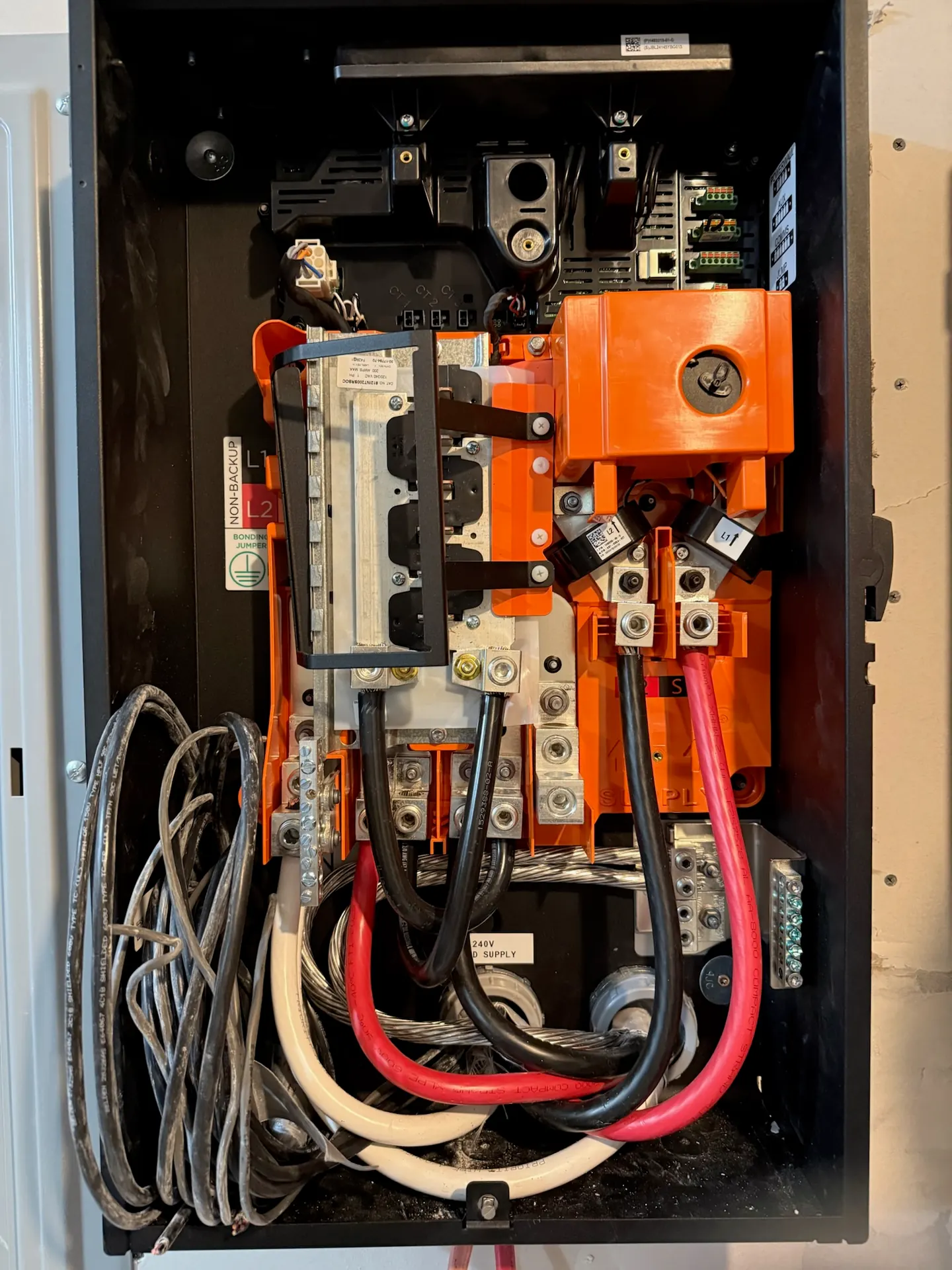
Now onto the bonus topics I promised earlier. Without a smart panel, backed-up circuits are moved to a separate critical loads panel and the rest of the home stays dark. A smart panel like SPAN lets us back up the whole panel and choose which circuits run from an app (see our write-up on smart panels). If you pair your partial home solar and battery system with a smart panel we gain some amazing features in regard to both Air Conditioning/Heat Pumps and Electric Water Heaters or other larger 240volt loads. Based on solar availability and battery state of charge you can toggle on these circuits using your smart panels application. For Air Conditioning, summer outages often happen during the day, when solar is producing the most. In that case solar could directly run the AC and then with the app be toggled back off later in the day when solar energy is less. Luckily here in Colorado most nights it gets relatively cool enough so that opening windows is generally a feasible option to keep your home cool. Even with a partial home setup if you were relatively conservative with power you could technically run your AC off of battery well into the evening safely. One tip: have a soft starter installed on the AC. Air conditioners pull a large surge of current for a split second when they start, and a soft starter reduces that surge so the battery can start the AC without overloading. The same smart panel setup works for water heaters: toggle the water heater circuit on while the sun is out, let it heat a tank of water for showers, and then toggle it back off.
EV charging and vehicle-to-home backup
EV charging pulls 7 to 11 kW, more than most home battery systems can spare during an outage, so we leave the EV charger off backup. But EVs can also work the other way. Bidirectional charging, which lets an EV send power back to the home, is available today on a few models, and more are coming over the next few years. I drive a Ford F-150 Lightning, and its battery is several times larger than a typical home battery bank.
Using an EV this way takes more than plugging it in: it needs a bidirectional charger and equipment that safely disconnects the home from the grid, which adds cost.
Of course, if your EV is your daily driver, you would have to be home with it plugged in. Some people may ask why not just use the EV as the battery, but we think having something that is always ready at your house is important. Where an EV really helps is if you have a bigger home or want to buy fewer batteries (which typically come in units of about 5 to 15 kWh), since the EV can fill the gap. Even an EV that can’t send power to the home can charge from your extra solar during the day of an outage. If you already own an EV, this could be a way to keep the lights on for a very long time.
Why partial-home backup makes sense on the Front Range
As we can see, while grid outages can be frustrating, a partial home solar and battery system works for most homes here in Colorado. In an outage, most people want to keep the lights on and the house warm, and partial home backup does exactly that for roughly $20,000 less than whole home backup. Not covered here is what the system does the other 99.7% of the time: saving you money every day the grid is on. A system that cuts your bill year-round and covers your essentials in the rare outage is why partial home solar and battery makes sense on the Front Range.