
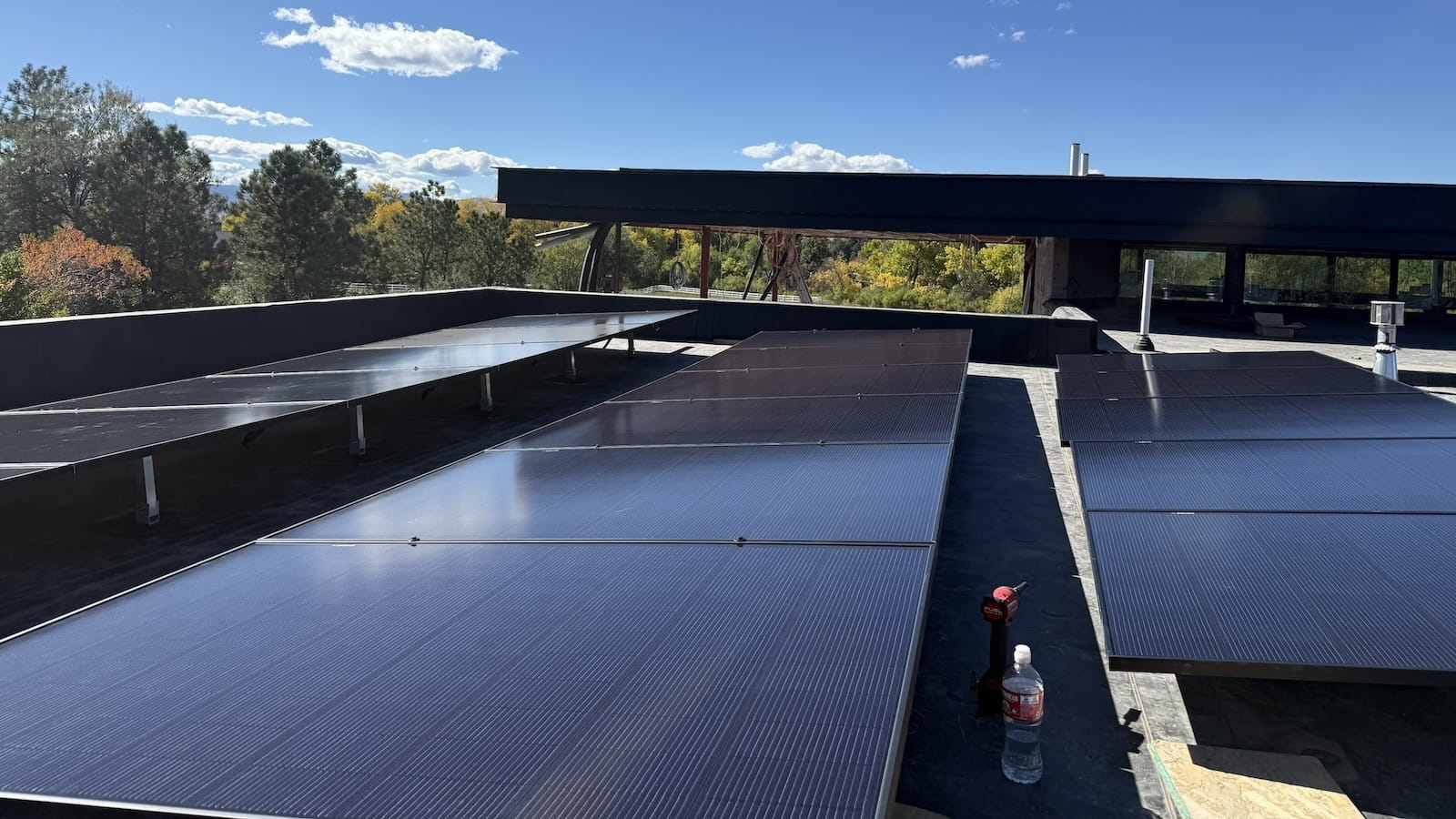
Deciding between a Generator and either Battery with Solar or a battery is a tough decision. On one hand you have a cheap and proven technology that can run indefinitely if tied into your home’s gas supply. While on the other hand you have newer technology that is more expensive and leaves you with a similar feeling EV owners get with range anxiety. In this write up I would like to explore the return on investment when it comes to batteries with solar vs a generator.
Comparing partial-home backup
For the sake of this analysis let’s assume we are trying to achieve partial home backup with both scenarios. Ok what is partial home backup (PHB) and why is it the best way to compare both products. PHB is choosing specific circuits in your home generally 120V circuits like lights and outlets. Smaller 2 pole 240v circuits can be backed up like small well pumps, or AC units. But generally, we stick to small circuits as start up currents from large AC units, Energy draw from hot tubs and EV chargers are too great to be backed up let alone be practical for backup. The main devices in your home we recommend you have on backup are internet, furnace if gas, lighting in the most used parts of your home, some kitchen plugs to make food, range if gas, garage door or other essential entry or exit components, bathroom outlets and lights, and bedroom lights and outlets. For the most part, any electrical device other than this is not a necessity during a grid outage.
Both our generator and solar and battery systems will be backing the same circuits found in a home that would be expected to be on a backup panel. On the generator side we will be looking at an 18kw natural gas generator. The equivalent of that with solar and battery would be a 20kWh battery bank with a 7 kW DC solar array. Now that we have two systems with very similar capabilities in what they can back up let’s dive into analysis.
The home and outage assumptions
As for our home we want to install both systems on, let’s choose a location somewhere in the foothills of Colorado. Our hypothetical house will face 1 multiday (2.5-4 day long, we will calculate at 3 days) outage every other year due to Xcel’s planned wildfire shutoffs, called Public Safety Power Shutoffs (PSPS). We will also face the average Colorado outage experienced by a home in Colorado of 3 to 6 hours (we will use 4.5 hours for our calculations) per year. Our battery system’s useful lifespan is about 15 years (more information below) so let’s look at this on a 15-year time horizon. In that 15-year span we will face 7 multi-day outages along with our yearly outage number. That brings us to 571.5 hours of the grid down time in that 15-year span at our hypothetical Colorado foothill home. I will also note that the numbers I am going to use will be generic and will not account for inflation. Trying to guess or calculate future values is outside the scope of this write up.
Upfront installation costs
On to the biggest deciding factor between the two systems, COST. It’s no secret that solar and battery are more expensive than a generator. For our scenario let’s assume we purchased and installed our generator for $18,000. That cost is for a home with no complications such as our gas service entering into the home on the other side of the house as the electrical or other project complications. Our solar and battery system is going to cost $45,000 to install. These prices assume no federal tax credit, since the 30% federal residential clean energy credit is not available for property placed in service after December 31, 2025. Let’s dive into the different pros and cons of each in a different categories.
Fuel and electricity costs
When comparing both systems, the biggest and most obvious expense is going to be fuel. One system is easier to answer than the other so let’s get that one out of the way right away. With a Battery system tied to Solar the energy going back into the system is free from the sun. Obviously, we can make the argument that we paid to get the solar which is true but let’s evaluate this on a total system cost perspective.
Now lets look at fuel costs for our generator. The average price for a therm of natural gas runs about ~$1. Lets assume the generator runs at a constant 50% capacity the entire time it runs and consumes 1.7 therms per hour. That brings us to a total therm use of 971.55 over our 15 years. And a total outage fuel cost of $971.55 or $64.77 per year. The generator cycles itself regularly throughout the month. The load it uses is likely not worth calculating so let’s tack on say $1 to the monthly cost, or $12 per year. That will bring our total outage fuel cost for each year up to $76.77.
Now a look at fuel costs for a solar and battery system. Because we will be using our solar and battery system in an energy arbitrage setup we should be minimizing or eliminating our electricity bill all together. Let’s assume an average home consumption of 12,000 kWh per year at $0.15/kWh, which works out to about $150 a month. A 7 kW DC array in Colorado produces roughly 10,500 kWh per year, so it offsets about 88% of that use, or about $1,575 per year (about $131 a month). In reality we will send more power back in the summer than winter, and the bill will never reach exactly $0 because Xcel’s fixed monthly service charge stays no matter what. That charge is paid with or without solar, so it doesn’t change the comparison. Again, this is extremely oversimplified but we can roll with it for this example.
Maintenance and warranty costs
Ok onto maintenance costs for both systems. For this category I am going to assume both systems get perfect installations and will not need any crazy maintenance items during their 15-year life. Because a generator needs to be maintained every year or 100 or so hours, we need to build this cost in. Let’s assume every year each visit costs $250. Additionally, the average customer will purchase an additional $1000 in extended warranties on their generator budgeted at a rounded $67 per year in the totals below.
Since we are assuming perfect installation and nothing will go wrong with the system there will be no additional costs associated with maintaining the solar and battery system. One caveat: most battery and inverter warranties run 10 years, so a repair in years 11 to 15 would come out of pocket. We are leaving that out on both sides, since we are also assuming the generator has no major failures.
What happens after 15 years?
We now have a good idea of what the lifespan costs associated with both systems will be. Before giving a final tally let’s take a quick look at what the end of life looks like for both systems. After 15 years let’s say the battery has lost about 30% of its original capacity, leaving it at 70% so a 10kWh battery when first installed is now only 7kWh. It’s not broken it just won’t store as much energy. Now we can make the argument that the replacement or additional cost is going to be the same price as it is today (anywhere from $250-$500/kWh in a finished product) but there is significant evidence that batteries could get as low as $80/kWh with the rapid adoption of sodium ion batteries or perfection of lithium-ion production. Simply adding one of these to the now 14kWh battery system boosts your storage capacity back above 20kWh at an affordable price. I will leave it up to the reader to justify what kind of cost this could be. I think considering this as a cost based on hypothetical technology and prices is not a productive exercise. As for the generator, we should see at least 10 more years of use, assuming no catastrophic failures and proper maintenance.
Comparing total costs
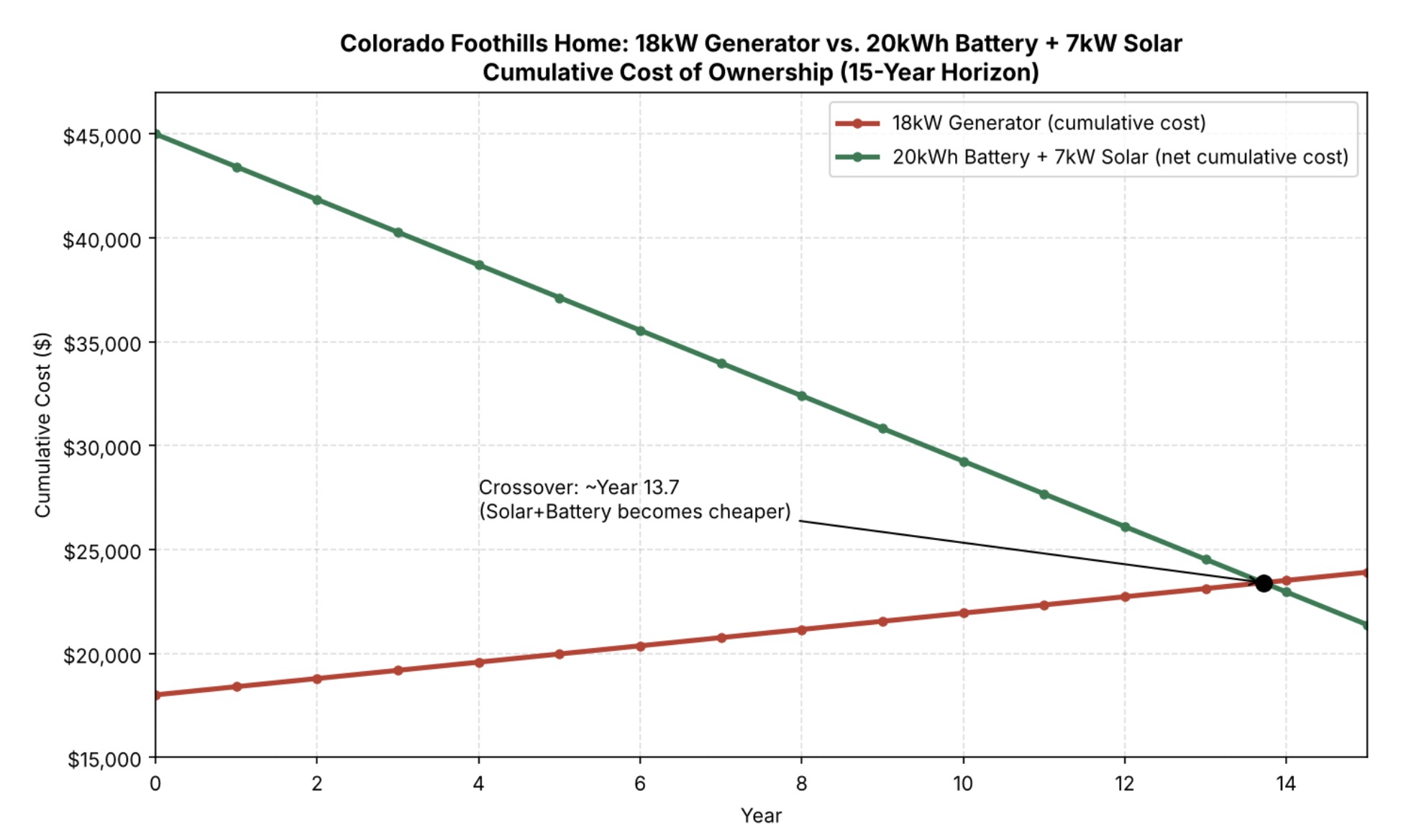
Now, let’s total the costs. The generator will cost $393.77 per year, or $5,906.55 over 15 years. The solar-and-battery system will save $1,575 per year, for total savings of $23,625 over the same period. After 15 years, the generator’s total system cost will be $23,906.55, compared with $21,375 for the solar-and-battery system. We can also recalculate the generator’s cost, assuming only the average Colorado outage duration of 4.5 hours per year. In that scenario, annual fuel costs fall from about $77 to about $20 (including the $12 per year to exercise the generator), reducing the total annual cost to $336.65. Over 15 years, that equals $5,049.75 in operating costs and a total system cost of $23,049.75.
15-year cost snapshot
- Generator with the assumed multi-day outages: $23,906.55 total, including installation, fuel, maintenance, and the rounded warranty allowance.
- Generator with only 4.5 hours of outages per year: $23,049.75 total.
- Solar and battery: $45,000 installation minus $23,625 in estimated electricity savings, leaving a net cost of $21,375.
A fair comparison: solar with either backup system
One important note on fairness: most of these savings come from the solar array, not the battery. A homeowner could also pair a generator with the same 7 kW array and get the same $1,575 per year in bill savings. In that case the real question is whether the battery itself is worth it compared to the generator. The battery portion of the system needs to be priced separately before comparing it with the generator’s $23,906.55 total over 15 years. On top of that, the battery earns extra savings on Xcel’s Time of Use rate by covering evening peak hours, needs no fuel or yearly service, and runs silently. Any additional time-of-use savings would need a separate calculation and are not included in the totals above.
What the comparison leaves out
Let’s review some of the main take aways from this exercise. If you live in an area that experiences more frequent outages, your generator costs will be higher than what is quoted in our calculations as you would hit the required hourly maintenance levels faster (more frequent maintenance visits) and use of more fuel. Even our 571.5 hours of outage over the course of 15 years equals about 0.5% of your time spent in the dark. A few things that are oversimplified or left out are rising utility costs whether that is natural gas or electricity. And rising costs associated with labor. These are relatively hard to predict but we can say for sure inflation will continue to increase labor costs in the future and will for sure increase utility costs for both natural gas and electricity.
Choosing between the systems
Choosing a generator should be thought of more like purchasing a new car. You are buying something that will only increase its cost to you, work for you about 0.5% of the time you own it and severely depreciating in value. A properly sized solar-and-battery system can provide backup for the selected circuits while reducing electricity costs. Its outage runtime depends on household demand, available battery capacity, and solar conditions; savings and payback depend on actual system performance and utility rates. Yes, a solar and battery system will depreciate but even after 15 years it will still be working for you and saving you money.